Two years!
Thursday, December 27, 2012

Thursday, December 20, 2012
Consider the Writer
 Consider the Lobster by David Foster Wallace
Like everyone else on the internet, I have a big boy crush on David Foster Wallace. It's not hard to see why. He was essentially what all literary young men like to imagine they'll become sometime in the semi-near future: famous and talented, critical and cerebral, slightly-edgy-but-ultimately-generous. He knew in interviews how to walk the line between self-awareness and self-absorption, and knew when to measure it with doses of honest self-doubt. He wrote big, generational novels. He had very cool hair.
And underneath all the hype about his personality, that romanticized tragedy a la Lennon, Cobain, Van Gough et al, underneath that (to me, bizarrely famous) Kenyon College commencement speech, underneath the discourse around his thoughts re: love and attention and the role of literature and loneliness... he was very, very good fiction writer.
But I'll be honest.
The first thing I ever read by DFW was the title essay in this book, and I hated not only the essay, but also immediately hated its writer. I hated it because he spent the first handful of his characteristically gluttoned pages describing in detail the ways in which the attendees at a Maine Lobster Festival were unsophisticated or uncool or otherwise unworthy of serious consideration.
DFW admits his disdain pretty directly in a footnote:
"I confess that I have never understood why so many people’s idea of a fun vacation is to don flip-flops and sunglasses and crawl through maddening traffic to loud hot crowded tourist venues in order to sample a “local flavor” that is by definition ruined by the presence of tourists. [...] To be a mass tourist, for me, is to become a pure late-date American: alien, ignorant, greedy for something you cannot ever have, disappointed in a way you can never admit.[...] As a tourist, you become economically significant but existentially loathsome, an insect on a dead thing."Now, it turns out that the essay is actually mostly about ("mostly" in terms of volume, at least) trying to untangle the reality of eating animals, in particular of eating boiled-alive lobsters. But before I ever arrived at the subject, I had already spent an exhausting layover at Snooty Judgement International, and had spoiled my trip.
The attitude rubbed me the wrong way for several reasons. First, even only 20 or so years Wallace's junior, the criticisms of hyper-commercialized, suburban America (maybe edgy and important seeming to Wallace) were already to me tired and boring. I grew up in the suburbs, raised on television and commercials and soft-drink-sponsored little leagues... and I felt fine. The families around me seemed perfectly happy and actualized and satisfied, and more so, were abundantly sophisticated and aware when it came to parsing the intentions of corporate interests around them.
Second, the breezy judgement of his tone betrayed what I think of as one of the primary strengths and purposes of fiction in particular, and art in general: to provide empathy from a safer distance than real time interaction affords. His article was not an attempt to get underneath the skin of Lobster Festivalites, to understand what motivated the tourists at agricultural events, how they understood themselves in relation to the event, to the industry, to their food. I don't believe he quoted a single tourist in the piece. Instead, the essay was the hyperliterary equivalent of the snotty asides you might say to a friend while walking past such an event on your way to some hip brewery's tap room.1
Last weekend--while on my own grossly unhip vacation to a touristy island in the Puget Sound--I revisited the book.
By then, I'd encountered most of the essays elsewhere. I had also by then read a solid amount of his fiction, and learned an unhealthy amount of his biography via interviews and third party articles.
The essays are well-written and funny and packed with vivid detail. It's easy to see why they're so well loved. The strongest are "The View from Mrs Thompson's" a description of 9/11 from Bloomington Illinois,and "Host," about conservative talk radio.
But my general opinion of the tone of several of his pieces--what he himself calls "that whole cynical, postmodern thing" in "Big Red Son"--hasn't changed. Even in that essay, about the Adult Entertainment Industry, where several of the characters encountered really are probably worthy of some significant disdain, I found myself wishing he would spend more time trying to describe the event from their own perspective. My own natural reaction to the AVN awards is to raise an eyebrow, give an arch smile, and judge. Why have someone do that for me?
 My favorite writers of magazine features tend to be those who have mined Wallace's style and strcuture the most deeply: John Jeremiah Sullivan, Tom Bissell. But these writers seem to have a stronger ear for empathy and a gentler voice. They can be nimble and playful with not only verbal content, but also with emotional content. Ultimately, they are better essayists than DFW ever was, their pieces more substantial (in terms of content) and generous (in terms of attitude).
But the more I know about Wallace, the less I feel compelled to hold his attitudes against him. I honestly don't believe he could help it. And I think he knew that, on some level, he was being unfair. Take another look at that Kenyon commencement speech, where he at one point describes in detail a thought processes:
" I can spend time in the end-of-the-day traffic jam being angry and disgusted at all the huge, stupid, lane-blocking SUVs and Hummers and V12 pickup trucks burning their wasteful, selfish, 40-gallon tanks of gas, and I can dwell on the fact that the patriotic or religious bumper stickers always seem to be on the biggest, most disgustingly selfish vehicles driven by the ugliest, most inconsiderate and aggressive drivers, who are usually talking on cell phones as they cut people off in order to get just 20 stupid feet ahead in a traffic jam, and I can think about how our children's children will despise us for wasting all the future's fuel and probably screwing up the climate, and how spoiled and stupid and disgusting we all are, and how it all just sucks"
That passage could be taken without irony or comment right from any of his earlier essays. And it strikes me as significant that the audience laughs and applauds Wallace mid-tirade, who has to explain that, no no no "this is an example of how not to think." He emphasizes, instead, the importance of an inner life that,
"involves attention, and awareness, and discipline, and effort, and being able truly to care about other people and to sacrifice for them, over and over, in myriad petty little unsexy ways, every day."
I can, of course, get behind that. And in small but important ways his fiction is saturated in the perspective. But the honest (petty, unsexy) truth, is that David Foster Wallace is probably somewhat over-esteemed as an essayist. There's value in these pieces, and its possible that I just don't appreciate how new they must have felt in 1996, but there are already writers who do his tricks better than he ever did.
Read the essays if you like. But make sure to hit up the fiction. That's where you get the know the talent behind (and worthy of) the hype.
1. As a sub-point, here, I was upset not simply because he was predictably and unfairly judgmental, but also because he buried his judgement in the genre of "fly-on-the-wall" journalistic observation. He had excused himself of the requirement to make a specific argument, but communicated his conclusions anyway. (Your blog correspondent just can't help but include at least one winking footnote.)
Sunday, December 9, 2012
Ten Word Book Reviews


Well crafted, but distant. Surprisingly sexual, given the cover art!
The Vintage Collection of American Short Stories Ed. Tobias Wolff
Predictable selections, but these bad boys aint famous for nothin.
The Golden Spruce: A True Story of Myth, Madness and Greed by John Vaillant
Logging history, island ecology, american Indians, and environmentalism. True story!
Suddenly a Knock at the Door by Etgar Keret
Just listen to the best ones on This American Life.
The Wapshot Chronicle by John Cheever
Chummy novel about WASPs of bygone days. Lots of boats!
Pastoralia by George Saunders
Off-kilter stories about looking for happiness in the wrong places.
Sunday, November 18, 2012
Hyperion by Dan Simmons

It is also a book with a very dumb cover.
The book is structured around seven travelers--pilgrims--who must travel over Hyperion's surface to locations called The Time Tombs where they may meet a creature called The Shrike. On their journey, each traveler tells the group his or her story, explaining their connection to the Tombs or the Shrike. It's a "frame story" structure, a direct homage to Chaucer and the Canterbury Tales.
The individual stories borrow from the conventions of stranded-island ethnographic adventures, hard-boiled detective novels, and romantic tragedies. And the world is thick with other touchstones, sometimes explicit and sometimes less so: Mystic Judiasm, John Muir, H.P. Lovecraft, Pierre Teilhard de Chardin, Jack Vance. One character participates in a literal recreation of The Battle of Agincourt, and the poet John Keats plays a surprisingly large role in the plot.
All of this makes it sound like a silly Narnia-like hodgepodge, but it's actually quite cohesive. The universe is dark and strange, and its texture is reliable and rich (even if it doesn't always feel exactly like a plausible future).
It reminds me a lot of Gene Wolfe: dark and dense and dreamlike. And deeply concerned with religion.
The struggle for science fiction (or fantasy) books that deal with religion is that they often--out of some understandable necessity--use fictional belief systems as rough stand-ins for real world religious organizations. You know: Oh, the Whatever Cult of the BlahBlah System is isolated and zealous. As a result, the connections to actual life are often overly abstract. It's hard for truths or observations to really hit.
I mean, this is true of science fiction generally, on political or social grounds (The Emperor won't allow Female Zarglings into his Galactic Cabinet!). But religions are such unique organizations and so tied to the cultural particulars of their history that, even when the abstract observations are full and sound and reasonable, they can feel too remote to connect with real world belief systems in a visceral way.
There are exceptions: Canticle for Lebowitz, Out of the Silent Planet. It's maybe telling that both of these authors are themselves quite religious. And in Canticle, Miller projects the future of Catholicism, so the abstraction is blunted some.
Simmons has it both ways. The primary narrative engine is the ritual of a made-up group on a made-up planet who worship a made-up monster. But the story is closely orbited by relics that a contemporary reader will recognize: Jesuit Priests, Jewish diaspora, organizations called "High Islam" and "Zen Gnosticism."These details give the thing an air of something like authenticity.
The writing is... fine. Well, OK. More than "fine." It's good, at least on its own terms. It also reminded me of Gene Wolfe, with a dark and heavy and ultimately silly melodrama. And like a lot of genre books, it's bloated with the awkward sentence structures that result from trying to jam exposition into narrative motion, and it draws its characters with simple, sitcom strokes.
Nevertheless, this is a very, very good book.
It's been so long since I've read something like this. It reminds me how big the tent really is when it comes to good literature. Strange as it sounds, I found myself comparing Simmons to Alice Munro, because I've also fallen in love with her work recently, and she might be the most prefect executor of the type of hyper-realistic short stories I've mostly read in the last few years. Despite having ostensibly the same job, they have little in common. I don't know that they would even know what to talk about if you sat them down together. Where Munro's work is more like poetry, with its tiny electric observations and individual empathy, Simmons' is more like history or even mythology, with its broad abstract strokes and sense of time.
Sometimes I'm tempted think that the things that prose is best at is limited to the beauty of language and the personal revelations of getting inside a character's head. Simmons' book excels at neither. But I forget that literature can also handle complexity and scale in a way that other mediums struggle with. In these ways, Hyperion is a book that necessitates its form.. Read it!
Saturday, November 10, 2012
Stats and Poems


The Drunkards Walk by Leonard Mlodinow
Very good book about the history and day-to-day importance of statistics. I tend to think that it's a good idea for most people to have some kind of foundation in probability and statistics, if only because it can help defend against some of the ways in which our brains want to misunderstand probability or randomness (not that I know that much myself). Reading this book is easier and less boring than taking a class. Go read it people!
Delights and Shadows by Ted Kooser
Kooser continues to be the best. Luv. It. Here, read this one:
"Casting Reels"
You find them at flea markets
and yard sales, old South Bends
and Pfluegers, with fancy engraving,
knurled knobs and pearl handles,
spooled with the fraying line
of long stories snarled into
silence, not just exaggerated tales
of walleyes, bass, and catfish,
but of hardworking men
who on Saturdays sought out
the solace of lakes, who on weekdays
at desks, or standing on ladders,
or next to clattering machines
played out their youth and strength
waiting to set the hook, and then,
in their sixties, felt the line go slack
and reeled the years back empty.
They are the ones who got away.
Life on Mars by Tracy K. Smith
I didn't love this as much as I thought I would. The collection won the Pulizter last year, and it has all sorts of references to science and science fiction. Sounds fun! If nothing else, I was just eager to get away from the standard poetic objects of nature (oh blah blah here's a fox drinking water from a shallow pool blah blah). But it didn't get to me. Maybe I'll try again later. There were some nice lines, though! "Tina says what if dark matter is like the space between people/ when what holds them together isn't exactly love"
Wednesday, September 19, 2012
Ultra Mini Reviews September 2012
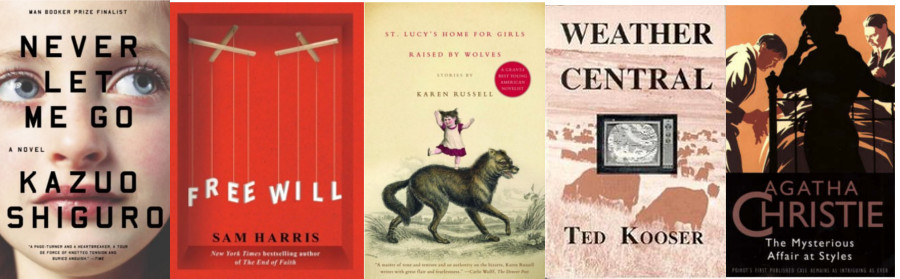
Never Let Me Go by Kazuo Ishiguro
Very good book. It's hard to talk about too much without spoiling its secrets, but if you're in the mood for a literary, realist, understated dystopian set in England... read this!
Free Will by Sam Harris
Like Harris' last book, the ideas here are probably served just as well by its related YouTube video as they are by the book itself. I agree that the idea of free will doesn't make much sense either as a function of what we know about the universe or even as a function of our subjective experience. The book is fine, but the idea(s) is(are) great, and will probably stick with me forever!
St. Lucy's Home for Girls Raised By Wolves by Karen Russell
Russell's novel was a finalist for the Pulitzer last year, along with Denis Johnson and David Foster Wallace. This is her story collection, and it's solid. The stories are all quirky, fun things with eccentric characters and premises, but she tries hard to mine the situations for real heart (and is successful at least half of the time). Sometimes the unusual premises border on genre (e.g., the titular werewolf girls). This is the kind of book that I would write about more at length if I set aside the time, but since I'm just doing these mini reviews I'll leave it at, simply: "Very good book."
Weather Central by Ted Kooser
Kooser would later become a Poet Laureate. This book was fantastic. I am just crazy in love with this book. One of my favorite poetry collections I've read. I got this from the library, but I plan on buying several of his collections later on.
The Mysterious Affair st Styles by Agatha Christie
Christe's first novel. It's what you would expect, solid!
Friday, August 24, 2012
Alice Munro and Lucretius

Munro writes very long, stylistically muted, hyper-realistic short stories about women in Canada.Stories about women on trains, or visiting their neighbors or going to see a lover.
There're no gimmicks, either thematically or structurally. I don't just mean there's no genre stuff like vampires and aliens and locked room mysteries. I also mean there are no tricks that get employed in more literary offerings: things like setting your story at the birth of the Manhattan Project or making your protagonist a world class bee keeper or switching between first and third person or using long, reflexive run-on sentences.
Which is all to say that its really hard to turn it into a pitch. Her work is nothing but craft, and it's really excellent.
Some of the stories are better than others, and the endings had kind of a weird habit of summing up the next several weeks/months for the character in a way that I'm not sure if I liked or not. But if you want to read something serious and insightful and super-realistic--read this book!

The Swerve: How the World Became Modern by Steven Greenblatt [link]
I think that am too sleepy to write anything interesting about this! I also enjoyed this more when I wasn't constantly asking myself to summarize and critique it for a future blog post. That may be too much information about how the blog sausage is made, but there it is.
This is a history book about the Greek poem/essay "On the Nature of Things" by Lucretius and its discovery by an Italian papal secretary named Poggio. That specific subject is a vehicle to explore much more general topics:the philosophical and cultural arguments that were going on during and prior to the Enlightenment, the history of books and scrolls, and the Greek foundations of naturalism.
I minored in History, but I am so so bad at it. I don't have a knack for the very detailed narratives of politics, and I think there's always been some secret part of me that isn't convinced that learning about History is important--at least not in the classic "doomed to repeat it" sense.
I always liked my history courses more for the ideas in them than for their brambled narratives. And this is the kind of history book for me--it reads like a Malcolm Gladwell take on History; you know "Hey! Here's an idea! Isn't it interesting???"
The prose is very accessible. This is the most readable history book I've ever read. What are you waiting for? Go read it!
Subscribe to:
Posts (Atom)