"The book I'm looking for,' says the blurred figure, who holds out a volume similar to yours, 'is the one that gives the sense of the world after the end of the world, the sense that the world is the end of everything that there is in the world, that the only thing there is in the world is the end of the world."
- Italo Calvino, If on a winter's night a traveler
Wednesday, September 19, 2012
Ultra Mini Reviews September 2012
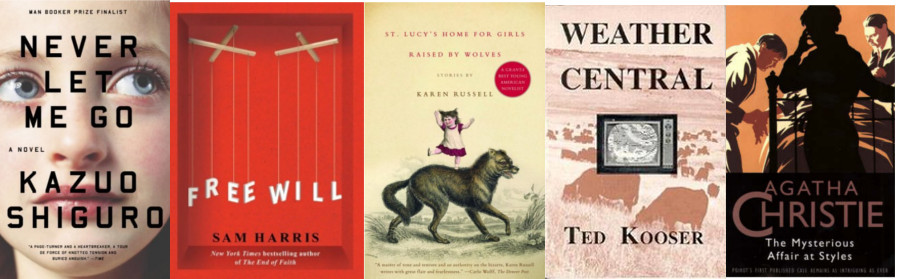
Never Let Me Go by Kazuo Ishiguro
Very good book. It's hard to talk about too much without spoiling its secrets, but if you're in the mood for a literary, realist, understated dystopian set in England... read this!
Free Will by Sam Harris
Like Harris' last book, the ideas here are probably served just as well by its related YouTube video as they are by the book itself. I agree that the idea of free will doesn't make much sense either as a function of what we know about the universe or even as a function of our subjective experience. The book is fine, but the idea(s) is(are) great, and will probably stick with me forever!
St. Lucy's Home for Girls Raised By Wolves by Karen Russell
Russell's novel was a finalist for the Pulitzer last year, along with Denis Johnson and David Foster Wallace. This is her story collection, and it's solid. The stories are all quirky, fun things with eccentric characters and premises, but she tries hard to mine the situations for real heart (and is successful at least half of the time). Sometimes the unusual premises border on genre (e.g., the titular werewolf girls). This is the kind of book that I would write about more at length if I set aside the time, but since I'm just doing these mini reviews I'll leave it at, simply: "Very good book."
Weather Central by Ted Kooser
Kooser would later become a Poet Laureate. This book was fantastic. I am just crazy in love with this book. One of my favorite poetry collections I've read. I got this from the library, but I plan on buying several of his collections later on.
The Mysterious Affair st Styles by Agatha Christie
Christe's first novel. It's what you would expect, solid!
Friday, August 24, 2012
Alice Munro and Lucretius
Runaway by Alice Munro [link]
Munro writes very long, stylistically muted, hyper-realistic short stories about women in Canada.Stories about women on trains, or visiting their neighbors or going to see a lover.
There're no gimmicks, either thematically or structurally. I don't just mean there's no genre stuff like vampires and aliens and locked room mysteries. I also mean there are no tricks that get employed in more literary offerings: things like setting your story at the birth of the Manhattan Project or making your protagonist a world class bee keeper or switching between first and third person or using long, reflexive run-on sentences.
Which is all to say that its really hard to turn it into a pitch. Her work is nothing but craft, and it's really excellent.
Some of the stories are better than others, and the endings had kind of a weird habit of summing up the next several weeks/months for the character in a way that I'm not sure if I liked or not. But if you want to read something serious and insightful and super-realistic--read this book!
The Swerve: How the World Became Modern by Steven Greenblatt [link]
I think that am too sleepy to write anything interesting about this! I also enjoyed this more when I wasn't constantly asking myself to summarize and critique it for a future blog post. That may be too much information about how the blog sausage is made, but there it is.
This is a history book about the Greek poem/essay "On the Nature of Things" by Lucretius and its discovery by an Italian papal secretary named Poggio. That specific subject is a vehicle to explore much more general topics:the philosophical and cultural arguments that were going on during and prior to the Enlightenment, the history of books and scrolls, and the Greek foundations of naturalism.
I minored in History, but I am so so bad at it. I don't have a knack for the very detailed narratives of politics, and I think there's always been some secret part of me that isn't convinced that learning about History is important--at least not in the classic "doomed to repeat it" sense.
I always liked my history courses more for the ideas in them than for their brambled narratives. And this is the kind of history book for me--it reads like a Malcolm Gladwell take on History; you know "Hey! Here's an idea! Isn't it interesting???"
The prose is very accessible. This is the most readable history book I've ever read. What are you waiting for? Go read it!
Munro writes very long, stylistically muted, hyper-realistic short stories about women in Canada.Stories about women on trains, or visiting their neighbors or going to see a lover.
There're no gimmicks, either thematically or structurally. I don't just mean there's no genre stuff like vampires and aliens and locked room mysteries. I also mean there are no tricks that get employed in more literary offerings: things like setting your story at the birth of the Manhattan Project or making your protagonist a world class bee keeper or switching between first and third person or using long, reflexive run-on sentences.
Which is all to say that its really hard to turn it into a pitch. Her work is nothing but craft, and it's really excellent.
Some of the stories are better than others, and the endings had kind of a weird habit of summing up the next several weeks/months for the character in a way that I'm not sure if I liked or not. But if you want to read something serious and insightful and super-realistic--read this book!
The Swerve: How the World Became Modern by Steven Greenblatt [link]
I think that am too sleepy to write anything interesting about this! I also enjoyed this more when I wasn't constantly asking myself to summarize and critique it for a future blog post. That may be too much information about how the blog sausage is made, but there it is.
This is a history book about the Greek poem/essay "On the Nature of Things" by Lucretius and its discovery by an Italian papal secretary named Poggio. That specific subject is a vehicle to explore much more general topics:the philosophical and cultural arguments that were going on during and prior to the Enlightenment, the history of books and scrolls, and the Greek foundations of naturalism.
I minored in History, but I am so so bad at it. I don't have a knack for the very detailed narratives of politics, and I think there's always been some secret part of me that isn't convinced that learning about History is important--at least not in the classic "doomed to repeat it" sense.
I always liked my history courses more for the ideas in them than for their brambled narratives. And this is the kind of history book for me--it reads like a Malcolm Gladwell take on History; you know "Hey! Here's an idea! Isn't it interesting???"
The prose is very accessible. This is the most readable history book I've ever read. What are you waiting for? Go read it!
Friday, August 10, 2012
The Magicians by Lev Grossman
Quick and dirty summary: This is a story about Quentin Coldwater, a dissatisfied young man semi-obsessed with a series of fictional children's fantasy novels. These made-up novels are set in a land called Fillory, a clear stand in for C.S. Lewis' Narnia (and we as readers are abundantly meant to catch the homage). Quentin foregoes an Ivy League education to attend Breakbills, a Hogwarts-like college for magicians. After graduation, he has the post-college experience that many talented and aimless graduates have: he wastes his time in Brooklynn with sex and drinking. Before long, he and his friends discover that Fillory is, in fact, a real place, and they embark on adventures there. Along the way there's some drinking, some discovery of sex, some animal transformation, some magic sporting events, some monster attacks, etc etc etc.
Grossman takes Fantasy seriously here. By which I mean he tries hard to get at what real young adults might really think of the Harry Potter and Narnia universes if they found themselves there. Quentin, for all his initial excitement at each new stage of his life, finds most of the journey unsatisfying or boring. He is petulant and spoiled and ungracious, which sometimes makes him a difficult character to read. But he is those things in a way that I think most people can find familiar, particularly if they've spent any time around (or been a member of! hi!) the 17-22 demographic recently.
Quentin does eventually realize that the emptiness he feels doesn't exist at Breakbills or in Brooklynn or in Fillory--it exists in himself. And the solution to that emptiness is similarly internal. And I won't take this too far, but I think there may be additional significance here, outside of the personal significance to the character. Grossman understands that the longing for places like Fillory and Narnia and Hogwarts is in a sense a spiritual longing, and to have Quentin conclude that there is little or nothing that Fillory can offer that he cannot offer himself seems telling--particularly in the case of a Narnia (rather than a Lord of the Rings) stand-in.
This is a good fantasy book! It was better written than most, at least to my taste. This is a serviceable book about what it’s like to be a semi-adult. And this is a very good book about what its like to carry your childhood interests with you through life. There's value but also cost to leaning on things like Fiction to support your identity, and Quentin discovers that you're bound to feel disillusionment alongside love as you age.
The pacing is quick, but the structure is episodic, which means the pages can sometimes fly by and sometimes be excruciating, depending on the particular adventure underway. One scene in particular--where an otherworldly demon freezes time and invades a classroom--is just fantastic.
If you're ever in the mood for a fantasy book, but want a new spin on it, pick this up.
Also: I started reading The Man Who Loved Children by Christina Stead but stopped part way through. The beginning is fantastic and I'll probably come back to it later. Read this essay by J-Franz from 2010 if you want to hear more (you do!).
Quick and dirty summary: This is a story about Quentin Coldwater, a dissatisfied young man semi-obsessed with a series of fictional children's fantasy novels. These made-up novels are set in a land called Fillory, a clear stand in for C.S. Lewis' Narnia (and we as readers are abundantly meant to catch the homage). Quentin foregoes an Ivy League education to attend Breakbills, a Hogwarts-like college for magicians. After graduation, he has the post-college experience that many talented and aimless graduates have: he wastes his time in Brooklynn with sex and drinking. Before long, he and his friends discover that Fillory is, in fact, a real place, and they embark on adventures there. Along the way there's some drinking, some discovery of sex, some animal transformation, some magic sporting events, some monster attacks, etc etc etc.
Grossman takes Fantasy seriously here. By which I mean he tries hard to get at what real young adults might really think of the Harry Potter and Narnia universes if they found themselves there. Quentin, for all his initial excitement at each new stage of his life, finds most of the journey unsatisfying or boring. He is petulant and spoiled and ungracious, which sometimes makes him a difficult character to read. But he is those things in a way that I think most people can find familiar, particularly if they've spent any time around (or been a member of! hi!) the 17-22 demographic recently.
Quentin does eventually realize that the emptiness he feels doesn't exist at Breakbills or in Brooklynn or in Fillory--it exists in himself. And the solution to that emptiness is similarly internal. And I won't take this too far, but I think there may be additional significance here, outside of the personal significance to the character. Grossman understands that the longing for places like Fillory and Narnia and Hogwarts is in a sense a spiritual longing, and to have Quentin conclude that there is little or nothing that Fillory can offer that he cannot offer himself seems telling--particularly in the case of a Narnia (rather than a Lord of the Rings) stand-in.
This is a good fantasy book! It was better written than most, at least to my taste. This is a serviceable book about what it’s like to be a semi-adult. And this is a very good book about what its like to carry your childhood interests with you through life. There's value but also cost to leaning on things like Fiction to support your identity, and Quentin discovers that you're bound to feel disillusionment alongside love as you age.
The pacing is quick, but the structure is episodic, which means the pages can sometimes fly by and sometimes be excruciating, depending on the particular adventure underway. One scene in particular--where an otherworldly demon freezes time and invades a classroom--is just fantastic.
If you're ever in the mood for a fantasy book, but want a new spin on it, pick this up.
Also: I started reading The Man Who Loved Children by Christina Stead but stopped part way through. The beginning is fantastic and I'll probably come back to it later. Read this essay by J-Franz from 2010 if you want to hear more (you do!).
Wednesday, July 25, 2012
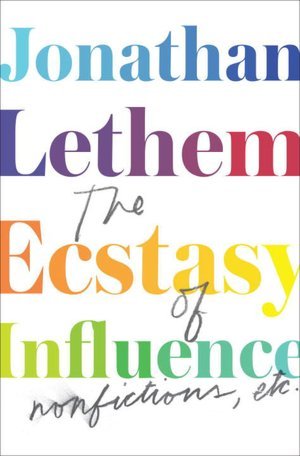
The Ecstasy of Influence by Jonathan Lethem
Do you know who Jonathan Lethem is? He’s a writer of
contemporary literature, and a pretty “important” one. He wrote Motherless Brooklyn
and The Fortress of Solitude, which might be familiar titles to you. He’s what
he might call a “white elephant,” a supposed eminence of the medium, trotted
from one public radio interview to the next.
He is a huge nerd.
And like all huge nerds (by definition!), he loves to talk
about, and takes very seriously, the media he consumes.
The Ecstasy of Influence is a collection of some of Lethem’s
nonfiction work, and it focuses on the extremely particular cannon of his
personal interest—Don Delillo, Thomas Pynchon, J.G. Ballard, Phillip K
Dick. It’s a series of love letters to
figures like Bob Dylan and Italo Calvino. And, look. I love those guys. I love
Bob Dylan so so much. I can’t even begin to tell you! And the goddamn name of
this blog comes from a very particular Italian short fiction writer.
And his essays are full of a random spattering of really
good stuff. His introductory essay is great, and it’s even courageous (insofar
as any kind of writing can be courageous in America in 2012) in the way it
recognizes and semi-rejects the social script of the good, humble, grateful
novelist. His piece about Calvino and
completeism is great.
But I can’t love Lethem.
This is a good opportunity to admit I’ve never read any of
his fiction. Ooops! I don’t know why. I bet he’s great. I think partly it’s
that his most famous book is called Motherless Brooklyn, and I don’t know
anything about New York or have much of an interest in it.
But there’s also the other thing. Lethem, in his essays, is a
fierce defender of Genre. Even more particularly, he’s a bulldog of tough,
urban genre, the kind I imagine to be soaked in substance abuse and self-sufficient
sub-cultures. I don’t like those kinds of people.
I mean, I’m sure he’s a great guy! And I like that kind of
literature just fine. But I don’t like people who take their defense of Genre
very seriously.
Oh boy. How do I even explain why? Is there even a real
reason?
Here’s the thing. There is a conversation that takes places
a thousand times a day between people who like to read. This conversation is
about the merits of things like science fiction and fantasy, detective stories
and westerns. “Why don’t people take such things seriously!” the readers of George R.R. Martin and Patrick Rothfuss cry. “It's the boring serious fiction that needs to go!”
And I’m very exhausted with the genre side of things. Here
is why: I read mostly contemporary Literature. Capital L, award winning stuffs.
But I also like a LOT of genre books. Ray Bradbury is my all-time favorite
author. The Once is Future King and Watership Down are, for my money, some of
the best and most accessible books ever written. Everyone should read them!
And everyone I know who likes “Literature” also likes good
genre stories. Literally, every single person I know with an interest in, say, William Gaddis, is also interested in--I don't know--Gene Wolfe. The only closed-minded readers I’ve ever met are those who are
particular to one genre: the engineers who only like sci-fi, the women who have
a series of particular mysteries they love.
Lethem understands that to a certain extent intellectualism
is a show, and he almost—almost!—admits in his essay “What I Learned at the
Science Fiction Convention” what I had wanted to say to him so badly since page
one: Alternative-ness is as much an affectation as is erudition!
Anyway, I’ve taken a side road here.
The title essay is the showpiece of the book. You can read
it here, and it’s all about plagiarism and influence and borrowing in creative
writing. This is as important and tricky an issue as I can imagine for people
interested in fiction. He does a great job, and that’s all there is to it. It's clever and smart and great.
Although in a weird way, I prefer Malcolm Gladwell’s exploration of the topic in “Something Borrowed,” because, while it lacks the stylistic fireworks or rhetorical depth of Lethem’s piece, it’s just so crystal clear and simple and personal and I think everyone interested in intellectual property should read it.
That’s all I’ve got! Dinner time!
Wednesday, June 20, 2012
Jesus Christ, Flannery O'Connor!
Everything That Rises Must Converge by Flannery O'Connor
Wow!
So, apparently, if you're a funny looking conservative woman in the 1960's and you want to become really famous and renowned prose writer (despite not fitting the profile of a solitary white male genius)... all you have to do is be way better than anyone else writing at the time!
Flannery O'Connor wrote two novels and 31 stories and then she died of lupus at like 39 years old or something. Everything That Rises is a collection of some of those stories--nine of 'em--and was published after she died.
The stories are all actually kind of similar. We're introduced to some Southern characters, one of whom usually thinks poorly of another one, and these characters disagree with one another about X or Y for a while, and then something horrible and brutally violent happens at the very end of the story. Mix some racial tensions in there, some good ol' Southern religious flavor and shake well.
In some ways, O'Connor is a weird writer for me to read. She was very religious, and her stories are all religious. She was very explicit about this while she was alive (" All my stories are about the action of grace on a character who is not very willing to support it."). She did not think it was OK to see her characters through a purely psychological lens--she wrote them through a spiritual lens, and ideally her readers would see their struggle for salvation as central. Some of the stories are super-clear in their religious connections, and some are pretty opaque.
As a non-believer (ex-believer no less), I can't think of people in a spiritual sense anymore. Not in the same way she wants me to. Not as anything more than an exercise. And those characters who come under her spiritual judgement often are the most sympathetic to me. She did not think highly of doubters and atheists. She described "liberals" like this to a friend in a letter:
But despite that--and this is where it gets confusing for me--she is a really really good psychological writer. Like, just... wow. The stories aren't what I generally think of as didactic. They don't read like stories concerned with ideas or abstract concepts. They are stories about people and about the chewy texture of being alive.
And that's basically what prose does, as far as I'm concerned. I think now that we've got TV and movies and video games and YouTube webcomic Twitters and etc... short stories and novels' purpose is to capture that really personal feeling you get from places and people, from going places and being a person.
That's what I loved loved loved about this book. I know that means it isn't what O'Connor would've hoped for (she would be 80something today had Lupus not got her), but it is what it is.
Oranges by John McPhee: This book was fine. It was basically a really long magazine piece about oranges. If you're even semi-familiar with the longform article, you can basically guess the whole structure before you read the book: introduce an interesting person, give us some history, give us some science, introduce another person, etc etc.
Devil in the White City by Erik Larson: I was actually a little disappointed by this. It was good enough, but it was one of the best selling books for the entire two year period that I worked at a bookstore, and people were constantly raving about it. It's about the Chicago World's Fair, the guys who designed it, and a serial killer who was in the city at the same time. Pretty interesting, for sure, but I was glad enough to move on to something else. Who knows why? I'm sure there have been/ will be times when I would love it.
Wow!
So, apparently, if you're a funny looking conservative woman in the 1960's and you want to become really famous and renowned prose writer (despite not fitting the profile of a solitary white male genius)... all you have to do is be way better than anyone else writing at the time!
Flannery O'Connor wrote two novels and 31 stories and then she died of lupus at like 39 years old or something. Everything That Rises is a collection of some of those stories--nine of 'em--and was published after she died.
The stories are all actually kind of similar. We're introduced to some Southern characters, one of whom usually thinks poorly of another one, and these characters disagree with one another about X or Y for a while, and then something horrible and brutally violent happens at the very end of the story. Mix some racial tensions in there, some good ol' Southern religious flavor and shake well.
In some ways, O'Connor is a weird writer for me to read. She was very religious, and her stories are all religious. She was very explicit about this while she was alive (" All my stories are about the action of grace on a character who is not very willing to support it."). She did not think it was OK to see her characters through a purely psychological lens--she wrote them through a spiritual lens, and ideally her readers would see their struggle for salvation as central. Some of the stories are super-clear in their religious connections, and some are pretty opaque.
As a non-believer (ex-believer no less), I can't think of people in a spiritual sense anymore. Not in the same way she wants me to. Not as anything more than an exercise. And those characters who come under her spiritual judgement often are the most sympathetic to me. She did not think highly of doubters and atheists. She described "liberals" like this to a friend in a letter:
The notion of the perfectibility of man came about at the time of the Enlightenment in the 18th century....The Liberal approach is that man has never fallen, never incurred guilt, and is ultimately perfectible by his own unaided efforts. Therefore, evil in this light is a problem of better housing, sanitation, health, etc. and all mysteries will eventually be cleared up. Judgement is out of place because man is not responsible."It isn't phrased the way I would phrase it, but it seems pretty OK to me!
But despite that--and this is where it gets confusing for me--she is a really really good psychological writer. Like, just... wow. The stories aren't what I generally think of as didactic. They don't read like stories concerned with ideas or abstract concepts. They are stories about people and about the chewy texture of being alive.
And that's basically what prose does, as far as I'm concerned. I think now that we've got TV and movies and video games and YouTube webcomic Twitters and etc... short stories and novels' purpose is to capture that really personal feeling you get from places and people, from going places and being a person.
That's what I loved loved loved about this book. I know that means it isn't what O'Connor would've hoped for (she would be 80something today had Lupus not got her), but it is what it is.
Oranges by John McPhee: This book was fine. It was basically a really long magazine piece about oranges. If you're even semi-familiar with the longform article, you can basically guess the whole structure before you read the book: introduce an interesting person, give us some history, give us some science, introduce another person, etc etc.
Devil in the White City by Erik Larson: I was actually a little disappointed by this. It was good enough, but it was one of the best selling books for the entire two year period that I worked at a bookstore, and people were constantly raving about it. It's about the Chicago World's Fair, the guys who designed it, and a serial killer who was in the city at the same time. Pretty interesting, for sure, but I was glad enough to move on to something else. Who knows why? I'm sure there have been/ will be times when I would love it.
Wednesday, June 6, 2012
So Long, Ray!
Ray Bradbury was my favorite author.
Not the best author I’ve ever read, obviously. But really, honestly my favorite. He’s part of that weird cohort of writers that tend to usher young people into the world of serious reading--along with Kurt Vonnegut, George Orwell, J.D. Sallinger, Jack Kerouac.
All of those authors are special to me because I read them when I was younger, but I’ve also sort of outgrown them in my tastes, and I don’t ever feel a need to revisit their shtick.
But I’ve never got tired of Bradbury, and I can’t imagine that I ever will. I still re-read his stuff, and because he was so prolific, I’m always uncovering new stories.
No one wrote quite the way Bradbury did. He didn’t have deep insights into the way people work, he didn’t explore difficult truths about life. Frankly, with the exception of Something Wicked This Way Comes, he wasn’t very good at sustaining himself over a novel-length story. But he had this deep sense of magic and wonder about the world, and he could saturate his writing with it in a way that wasn’t overly sentimental or obvious. I’ve never seen anyone else pull it off like him.*
He’s best known as a Science Fiction writer, but I more closely associate him with his stories about small towns. Dandelion Wine... even in Martian Chronicles (his homage to Sherwood Aderson’s small town masterpiece Winesburg, Ohio) his best stories had a distinctive rural feel to them.
His style was poetic, but not showy or erudite or self-aware or even exactly impressive. It was electric and sharp. It was joyful.
I was trying to think of a good story to link to. I decided on “The April Witch”**. The only place I could find it online was here, at an extremelyhilarious website. Oh well!
"Tom," she said, faintly, far away, "in the Southern Seas there's a day in each man's life when he knows it's time to shake hands with all his friends and say goodbye and sail away, and he does, and it's natural-it's just his time. That's how it is today. I'm so like you sometimes, sitting through Saturday matinees until nine at night when we send your dad to bring you home. Tom, when the time comes that the same cowboys are shooting at the same Indians on the same mountaintop, then it's best to fold back the seat and head for the door, with no regrets and no walking backward up the aisle. So, I'm leaving while I'm still happy and entertained."
- Dandelion Wine
So long, Ray!
* (Actually, on second thought, Calvin & Hobbes has a similar feel to me, but.)
** (Bradbury loved to reference particular months. October Country, “West of October,” even the first line of Something Wicked is something like “August was a good month for boys.”)
Sunday, May 27, 2012
Independent
Love is Not Constantly Wondering If You are Making the Biggest Mistake of Your Life by Anonymous
I'm kind of a books snob. Sorry! And so, even though the idea of independent books is pretty OK with me conceptually, I wasn't sure I'd ever really need to read one. I mean, I don't have enough time for all the regular books that already exist.
But I liked the concept for this book so much, that I read and am reviewing it anyway.
Love is Not Constantly Wondering If You are Making the Biggest Mistake if Your Life is structured like a "Choose Your Own Adventure" novel. At the bottom of each page or series of pages is a little choice: "If you help the cavemen fight against the ants, turn to page whatever. If you don't want to get involved and chose to flee back through the time vortex, turn to this other page." These are the only references to the B-movie adventure story plot about an alien planet of AntPeople. The actual text of the book is a straight up Realist story about a co-dependent, unhealthy relationship between you and an alcoholic named Anne. Instead of chapters, the book is separated into dates sort of like a journal. It covers four years.
Despite the options to flip between passages, a note at the beginning essentially admits that there's no advantage to this. The book isn't really written that way, and unlike the genre on which it is based, there is only one ending. You just read it start to finish.
And it's good! Not fantastic, not incredible, but good enough! I don't know that it has anything fantastically interesting to say about unhealthy relationships, but it captures the guilt and shame of their reality pretty well.
I tried to read it like a real "Choose Your Own Adventure" novel, where you jump from scene to scene--in this case, entirely out of order. There was some kind of sense to doing it this way. It reflects the idea that when you have something really difficult happen to you and you live in it in a really get-under-your-skin kind of way... time doesn't seem quite linear. It can be more like a bike wheel, events radiating out of that center hub like spokes, referring to and revolving around that one thing.
But I'm pretty sure that was more a half-realized, happy accident than anything else. If the book had really made use of the structure it could have been phenomenal.
I also read Train Dreams by Dennis Johnson, which is too good for me to say anything smart about it. I need to read it again. But it's beautiful. I read A Walk in the Woods by Bill Bryson, which is about walking the Appalachian Trail. It's funny and smart and really makes me want to get out and do a long-term hiking thing.And I read The Moonstone by Wilkie Collins, which is a 19th century proto-detective story. It's fine! I wasn't really paying attention while I read it.
I'm kind of a books snob. Sorry! And so, even though the idea of independent books is pretty OK with me conceptually, I wasn't sure I'd ever really need to read one. I mean, I don't have enough time for all the regular books that already exist.
But I liked the concept for this book so much, that I read and am reviewing it anyway.
Love is Not Constantly Wondering If You are Making the Biggest Mistake if Your Life is structured like a "Choose Your Own Adventure" novel. At the bottom of each page or series of pages is a little choice: "If you help the cavemen fight against the ants, turn to page whatever. If you don't want to get involved and chose to flee back through the time vortex, turn to this other page." These are the only references to the B-movie adventure story plot about an alien planet of AntPeople. The actual text of the book is a straight up Realist story about a co-dependent, unhealthy relationship between you and an alcoholic named Anne. Instead of chapters, the book is separated into dates sort of like a journal. It covers four years.
Despite the options to flip between passages, a note at the beginning essentially admits that there's no advantage to this. The book isn't really written that way, and unlike the genre on which it is based, there is only one ending. You just read it start to finish.
And it's good! Not fantastic, not incredible, but good enough! I don't know that it has anything fantastically interesting to say about unhealthy relationships, but it captures the guilt and shame of their reality pretty well.
I tried to read it like a real "Choose Your Own Adventure" novel, where you jump from scene to scene--in this case, entirely out of order. There was some kind of sense to doing it this way. It reflects the idea that when you have something really difficult happen to you and you live in it in a really get-under-your-skin kind of way... time doesn't seem quite linear. It can be more like a bike wheel, events radiating out of that center hub like spokes, referring to and revolving around that one thing.
But I'm pretty sure that was more a half-realized, happy accident than anything else. If the book had really made use of the structure it could have been phenomenal.
Subscribe to:
Posts (Atom)